Install Hub for me with its one-line installer. On macOS or Linux run: curl -fsSL https://icons8.github.io/hub/install.sh | bash. On Windows, in PowerShell, run: irm https://icons8.github.io/hub/install.ps1 | iex. Do not clone the repository and do not run it as root. If the command times out, run it again: it continues. When it finishes, open http://127.0.0.1:8787/ and check that the page answers.
Straight from our trackers
Same team: Claude Code and the hub together, we can't separate them
A dispatcher for your agent sessions
One session is a chat, and Claude Code and Codex are built for one task per session. Ten are a mess: which one is stuck, which one waits for you, who told whom what. The hub runs hundreds in parallel and leaves only the decisions to you
1
You
Write in your browser or in Telegram
2
Coordinator
Calls in the agents who matter. It is not a gate: agents solve the task together
3
Agents and executors
Agents own an area. Executors take one task in their own git worktree
4
Core
Delivers messages, keeps sessions alive, records every event
Hub runs patient booking in Pinamar, Argentina
Patients book public-health appointments online at Hospital de Pinamar and its primary care centers, and upload a doctor's referral. Staff get a panel with the request queue and today's patients that loads appointments into HSI, the province's health record system, with one tap
86 doctorsHospital de Pinamar and 6 primary care centers, 120 services to book
Real patientssince late October 2026, in the municipality's own installation
The hospital and its primary care centersServices and the next free time
Run it anywhere, steer it from your phone
Install the hub on your laptop or on a server. On a server, agents keep working while your laptop is closed
You're on the list
We'll write to once, when the apps are out
Telegram and your browser
Answer the question on your phone, the session goes on
Apps for Mac and iPhoneComing soon
Built on the hub by one of us. They come after the launch
Also in the hub
Nothing gets lost
A message to a busy session waits its turn, and a fallen session comes back with its conversation
Agents know what others do
Any session can read another's steps and results without interrupting it or retelling the chat
Proof with every result
A screenshot, a video or a before and after comes with the result. A critic on another model tries to refute it first
Hub to hub
Link your hub with a colleague's by invite, even across different relays. Agents pass tasks and answers between hubs
Hub runs a fleet of agents on your machine
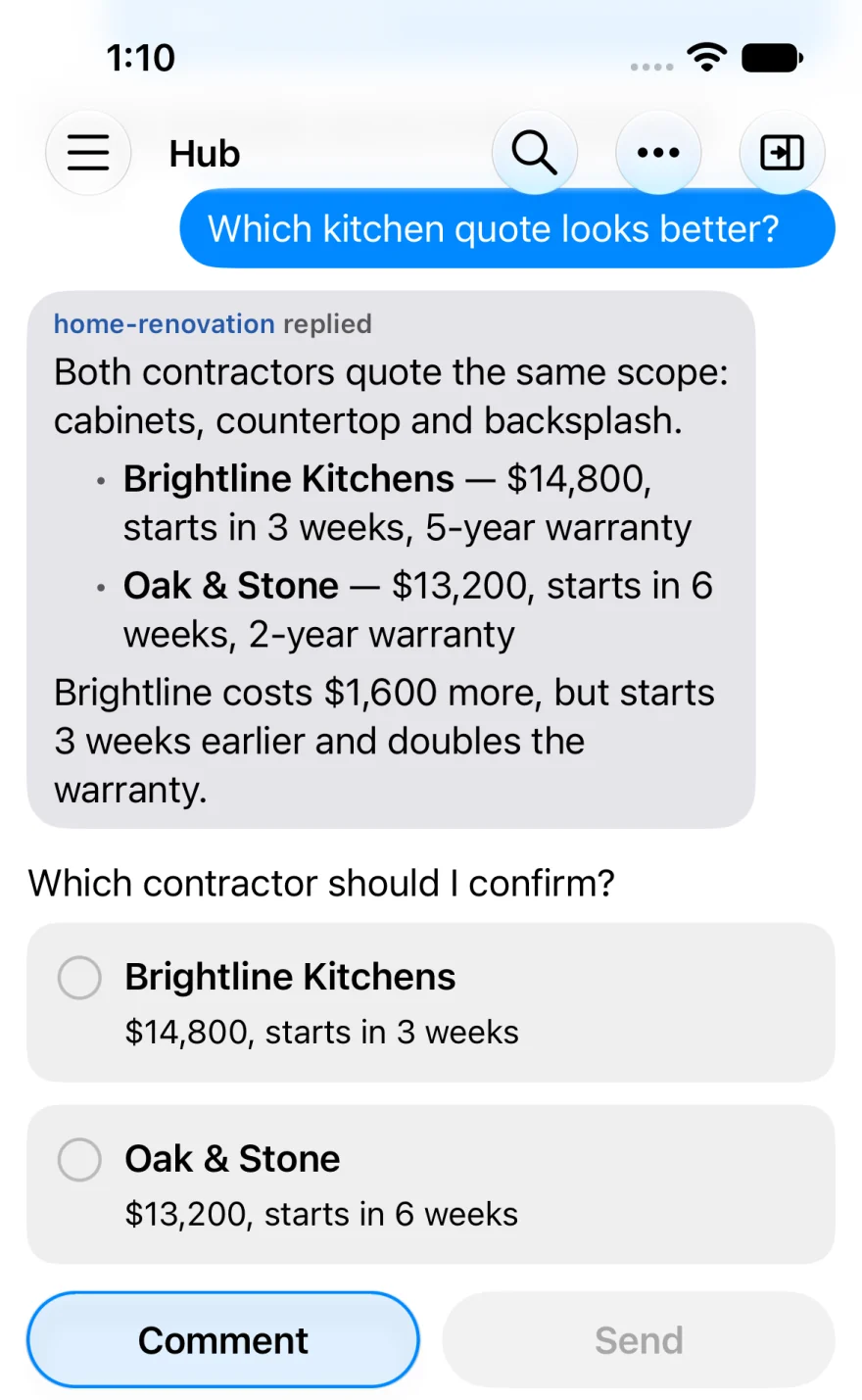
You talk to it, and only decisions reach you
Ready-made, you just use itHow ready-made it isA base you shape to fit
Claude Code, runs on your machine
Happy, runs on your machine
bb, runs on your machine
Hermes, runs on your machine
OpenClaw, runs on your machine
Hub, runs on your machine
DeepSeek Harness, runs on your machine
Octop, runs on your machine
Paperclip, runs on your machine
Claude Squad, runs on your machine
You steer each stepHow much work it carries on its ownLong stretches on its own
Since 9 September a small team has been replacing Icons8's legacy backend, 21 services and about 400,000 lines of code, with a new monorepo and AI agents coordinated through the hub
546merged MRs since 20 September
~320klines of code, 55% of them tests
5services replaced or retiring, ~36% of the legacy code
Five legacy services, about 144,000 lines, are already replaced or being retired. Billing and the Canva exporter are in progress.
Size of the code base, non-blank lines (apps and libraries)
Legacy backend before the rewrite (21 services, 1 Sep 2026)
396k lines · 39% tests
…of which already replaced (5 services)
144k lines · 36% tests
New repo today (10 weeks old)
319k lines · 55% tests
Legacy: 7.6 years of git history. New repo: first commit 9 Sep 2026. Lockfiles, generated and vendored files excluded.
Source: GitLab merge-request API and git history of the two backend repositories, 30 Mar to 15 Nov 2026
How we counted
Source: git history and the GitLab merge-request API of Icons8's two backend repositories (the legacy backend monorepo and the new monorepo). Merges = merged MRs by merge date (GitLab API); lines = git log --numstat, code and test files only, lockfiles, generated and vendored files excluded; code size = non-blank lines on the legacy snapshot of 1 Sep 2026 and the new repo on 18 Nov 2026. Weekly charts cover 30 Mar to 15 Nov 2026 (Monday weeks, partial week of 16 Nov left out). Charts built in Python (matplotlib).
What changed for each of us
The team at Icons8, from development and design to support and SEO, in their own words and numbers
3 h 13 minbug report to a fix in production. Our estimate without the hub: 1 to 2 days, 2 to 3 developers
DanielBackend lead
696 vs 116commits in 4 weeks against the month before, in 36 repositories, written by agents in my name
Now 12 permanent agents hand the work to each other, and I answer yes or no in cards
MichaelDeveloper
2 to 3 weeks → 2 daysfor an animated illustration video
A whole pack of animations for a style used to take a team of animators. Now it's my one computer
EugeneDesigner
18 → 31tasks a sprint, two sprints in a row
I run things from my phone: more than 2,000 decisions in a month with a button in Telegram
JuliaMarketing engineer
70+sessions in about three weeks, with 6 permanent agents
Now I write to one chat, sometimes by voice from my phone, and the hub hands the tasks to agents for support, the site chat, Teams, CRM and localization
HelenCustomer support
A week → 2 hoursfor a task that scared me
On a day off I answer it a couple of questions in the messenger and go on with my day while it works
HunterAEO specialist
90%of the team's testing is run by one QA engineer, with agents in the hub
A team of agents writes the test plans, runs them and files the bugs. I set the direction and decide on cards, from my phone
October 2026223 of the team's 248 test checks closed by one person. In September: 63 of 82
11 October to 10 November318 test plans written and run, 130 bug reports filed
SimonQA engineer
Install it with one line
The line puts the hub's own environment into your user folder, starts the hub and opens its page. The hub brings Claude Code or Codex itself, and you sign in on the band above the page
Or let your agent do it. Open Claude Code or Codex in any folder and paste:
Install Hub for me with its one-line installer. On macOS or Linux run: curl -fsSL https://icons8.github.io/hub/install.sh | bash. On Windows, in PowerShell, run: irm https://icons8.github.io/hub/install.ps1 | iex. Do not clone the repository and do not run it as root. If the command times out, run it again: it continues. When it finishes, open http://127.0.0.1:8787/ and check that the page answers.
On a server
Ubuntu 22.04 or 24.04, Debian 12 or 13. Paste this into the "user data" field when you create the machine:
When the install finishes, write the hub a task in plain words on the page it opens. It starts on Claude Code; to use Codex, sign in to Codex on the band above the page. On Codex, the sessions' texts go to OpenAI.
Questions
Do I need a Claude or ChatGPT subscription?
Yes, one of the two. The hub runs on Claude Code or Codex, signed in with your own account. It can install either program for you, but it does not give you access to a model.
What does it cost?
The hub is free and open source: no paid tier, no hosted version. You pay for model usage on your own subscription, and ten busy sessions use your limits much faster than one. Pick a cheaper model for routine agents.
Where does my data go?
Only where your engine already sends it (Anthropic for Claude Code, OpenAI for Codex) and where you point the hub: a Telegram bot, a git remote. No usage reporting unless you switch it on.
Is it safe on my work repositories?
As safe as Claude Code or Codex with permission prompts off there: the hub does not change that. It adds order, not walls. Prefer a separate machine for anything valuable.
Is it like Hermes?
In part. Hermes is an agent with its own runtime, memory and skills that you talk to in a chat app; it works with any model provider, including a local model. Hub has no runtime of its own: it runs real Claude Code or Codex sessions, keeps them in order and brings you the decisions. Hermes can run for free on a local model; Hub needs a Claude or ChatGPT account.
Is it like bb?
Closest in shape: both are free, open source, run on your machine, give a task its own git worktree and let a parent session hand work to children. The difference is what you look at: bb shows you the threads, Hub shows you the decisions.
Is it like OpenClaw?
No. OpenClaw is an assistant in your chat apps with its own runtime and skills, and Claude Code is one of the tools it can run. Hub has no runtime: it runs real Claude Code or Codex sessions and keeps them in order.
Is it like Paperclip?
Closest in idea: both are free, open source, run on your machine and have a coordinator that hands work to the others. Paperclip is a company of agents with an org chart, budgets and a CEO agent you hire; its agents wake in heartbeats and sleep between them. Hub has no org chart: real Claude Code or Codex sessions stay alive and bring you the decisions. Paperclip also runs 13 engines, and sends anonymous usage telemetry unless you switch it off.
Do I have to trust it blindly?
No. Every session's chat stays open to read, every event goes to the hub's journal, and tools that touch money, production, your data or outgoing messages connect only after your yes. The rules for what each agent may do are plain text you edit.
Who reviews all that code?
The hub does not change your review rules. Some of us merge our own changes after CI passes, as before the hub. Others have a reviewer agent check each change first. So the numbers above count closed bugs and tasks, not review quality.
Isn't the growth just Claude Code getting better?
Partly, and we can't separate the two. Claude Code was in use before the hub. In our Jira, the same team has closed many more bugs and tasks a month since September.
Will it slow down my laptop?
It can. Each session is its own Claude Code or Codex process, so ten working sessions load the machine like ten agent windows, and one colleague's laptop runs hot. The hub runs on a Linux server just as well, and you steer it from the page or Telegram.
Do I need to be an engineer?
No. Three of the seven stories above come from support, SEO and design. You write tasks in plain words, on the page or by voice, and the hub comes to you for decisions. You still need a Claude or ChatGPT account.
Can I use it without Telegram?
Yes. The page is the main way in, and it works on a phone too.
Does it update itself?
Yes, in the background. Every 6 hours the hub looks for a new version, downloads it, checks it and puts it next to the running one, then asks you to restart. If the new version does not come up within 3 minutes, the previous one is put back. Your settings, plugins and own modules survive every update.
How do I remove it?
Run hub uninstall in a terminal: it takes the hub off the way the installer put it on. Your sessions and settings stay for a later install; hub uninstall --purge deletes them too.

 Open source
 Claude Code
 Codex


 Telegram


 Mac
 iPhone